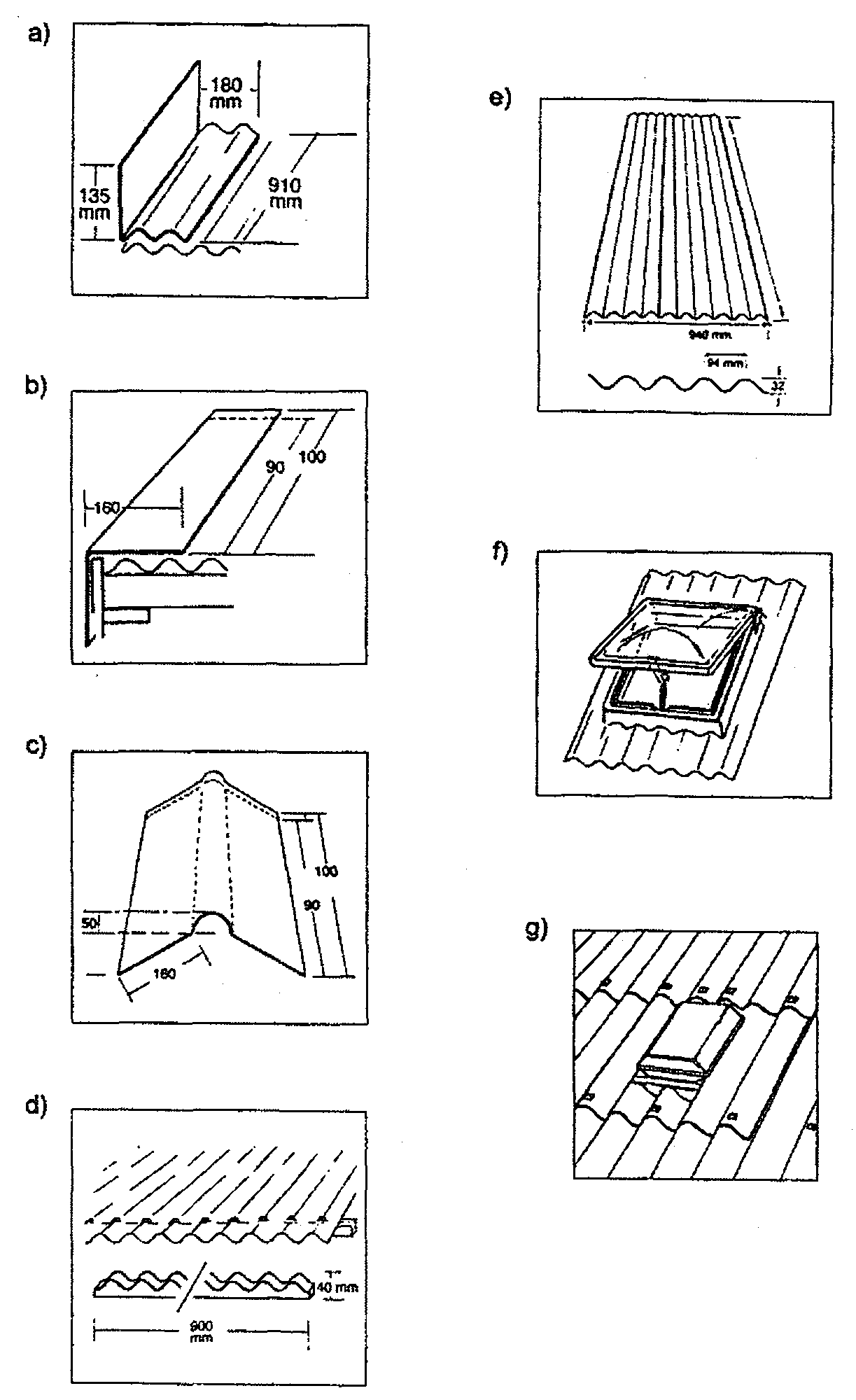
 In order to properly seal the roof edges and roof penetrations, additional elements should be used (accessories) except for the base elements of the covering, which are corrugated bitumen sheets. Additional elements including the basic elements of hard?they plow one whole and guarantee reliability, long-term tightness of the roof and its aesthetic appearance.
The most important additional elements of roofing with corrugated sheets include:
• Profile protecting the connection between roof slopes and the wall, perpendicular to the folds of the covering, designed to protect gaps, which are formed between the cover plate and the wall. It can be used with the roof inclination at any angle.
• A fitting for sealing the chimney parallel to the folds of the covering (shown in Fig. a). Its use improves durability, tightness and aesthetics of the roof.
• Gable angles used to properly finish the edges of roof slopes; they ensure the tightness of the roofing along the edges and protect the roofing panels against the suction effect of the wind (lynx. b).
• Roof ridge tiles used for any roof slope (lynx. c). Sealant made of black or white foamed polyurethane, adapted to the profile of the plates, prevents water and dust from getting under the cover and protects it from the wind (lynx. d).
• Transparent PVC plates, providing access of light to the attic rooms, used there, where diffused lighting is required. They have the same shape and dimensions as the cover plates. They are a simple and economical way of obtaining light through the roof, they are resistant to mechanical impact and weather conditions (lynx. e).
• A skylight allowing light and ventilation in the attic, serving also as an entrance to the roof (lynx. f).
• Roof vent allowing for ventilation of the attic space. Installation involves cutting holes in the cover plate, and then, while the boards are nailed, the wavy vent flange is also nailed along the edge to the battens - fig. g.